
Chess notation cheat-sheet (for new readers)
Pieces: K king · Q queen · R rook · B bishop · N knight · (a pawn move has no letter)
Actions: x takes · + check · # mate · O-O short castles · O-O-O long castles · e8=Q pawn promotes to queen
Annotations: ! good move · !! brilliant · ? mistake · ?? blunder
Sacrifices that crack open g8: h7, g7, and the Greek gift
Most of these positions hinge on giving up material to strip the pawn cover off a castled king. The Greek gift shows up constantly: the light-squared bishop takes on h7 with check (written Bxh7+, meaning bishop captures on h7 and attacks the king), the king grabs it, and the knight leaps to g5 (Ng5+, knight to g5 with check) while the queen heads for the h-file. When you see that pattern on the board, solve it by tracing every king escape first: g6, h6, or back to g8 each needs its own follow-up, and one of them usually refutes a lazy sac. Puzzles built around g7 are blunter. A piece lands on g7, the f6 knight or the king is forced to recapture, and the long diagonal or the g-file opens behind it. The classic bishop sacrifice and its double-bishop cousin live in the same family. The skill you drill here is the moment of commitment: read whether the sac forces mate or a winning attack before you play it, and hunt for the quiet zwischenzug that holds the line together, because missing it collapses the whole combination.
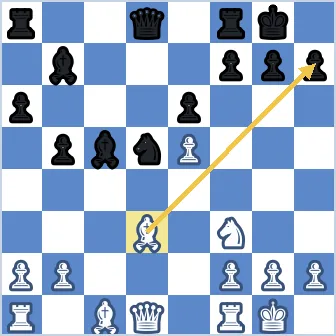
When the king storm beats the defense: forcing the breakthrough on the h- and g-files
Counting tempi. A pawn storm is a race, and these puzzles ask you to win it with force rather than slow buildup. Count your move-by-move threats against Black's defensive moves before you push anything. Prying the file. The h-pawn pushes from h4 to h5 (written h4-h5) and then trades or is met by g6, after which hxg6 (the h-pawn captures on g6) rips a lane for the rook. Once the file cracks, look for the doubled rook-and-queen battery that crashes through to h7 or h8. The rook lift. When the file stays half-closed, scan for a rook that swings via the third rank to h3 or g3 and joins the attack without waiting for pawns. The rating slider dials these breakthroughs up toward 2400 once the easier h-file mates feel automatic, and the puzzles come straight from real games, so the defense fights back the way a human would. Your job is to find the move order that mates before Black consolidates.
Reading the position before you commit pieces to the king
Several of these puzzles test restraint as much as aggression, so use a three-point checklist before you sacrifice anything. First, check the center: a locked pawn chain greenlights the storm, while an open center is your cue to hold fire because the counterattack lands first. Second, find the f6 knight, since it guards h7 and g4 and the Greek gift stays unsound until that knight is traded, deflected, or pinned. Third, count attackers against defenders around the king; if the queen cannot reach the h-file and no minor piece supports the entry square, mark the tempting sacrifice as a blunder and look elsewhere. Once those three boxes are checked, confirm the king has nowhere safe to run and that your next two pieces arrive with tempo. That is the green light. When the run squares are covered and the tempo holds, the forcing line is almost always sitting right there, and the puzzle rewards you for pulling the trigger instead of hesitating.