
Chess notation cheat-sheet (for new readers)
Pieces: K king · Q queen · R rook · B bishop · N knight · (a pawn move has no letter)
Actions: x takes · + check · # mate · O-O short castles · O-O-O long castles · e8=Q pawn promotes to queen
Annotations: ! good move · !! brilliant · ? mistake · ?? blunder
Spot the piece that has run out of squares
The whole motif turns on one habit: counting an enemy piece's escape squares before you reach for the attacker. A piece is trapped when every square it could move to is either covered by your forces or blocked by its own men. So the read comes first, the tactic second. As you solve, scan for any unit that sits deep in your half, parked on the rim, or boxed behind a wall of pawns, then ask how it would get home if you poked it.
Train your eye on the give-away signs the set keeps showing you. A bishop stranded on a short diagonal. A knight on the edge with two legal hops, both bad. A rook hemmed in with no open file and no safe square on its rank. When you read limited mobility correctly, the win is usually one quiet attacking move, not a long forcing line. These positions reward patience over flash, since the piece is going nowhere and you only need to make the threat real.
Drill the greedy grabs that backfire: bishops, knights, and queens that wandered too far
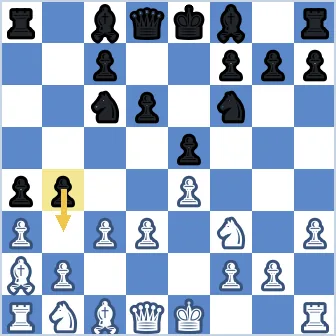
The greedy bishop. In these positions you punish …Bxa2 (the bishop captures the pawn on a2), answered by b3 (the b2 pawn steps to b3), where one pawn seals the diagonal and a piece brought to a2 wins the bishop. The mirror you will see is Bxh2 (the bishop takes the h2 pawn) met by g3, a quiet pawn push that boxes the bishop in. The rep teaches the pre-move check: before any rook-pawn snatch, count whether a single pawn push fences the bishop in.
The knight on the rim. The trainer feeds you knights that strayed to the edge or corner with few squares left, where a couple of pawns hem them in until there is nowhere to jump. Your job is to bring a piece to attack and collect.
The queen or rook that raided too deep. You also get poisoned-pawn grabs like Qxb2 (the queen helps herself to the b2 pawn), where the lines around the piece close and it is boxed in behind enemy ranks. When I built this set, the trainer pulled computer-verified positions from real games, so every greedy capture you punish here actually happened on the board.
Bring a second attacker once the escape is sealed
Cutting off the retreat is half the job. The other half is making sure the trapped piece cannot simply be defended in time. Once a piece is short on squares, the puzzle wants you to add a second attacker so the defender runs out of options: it can guard the piece or save it, but not both. That is how a position that looks merely awkward turns into clean material.
Drilling the finish is where most of the rating points hide. Set the slider anywhere from roughly 400 to 2400, and the positions meet you near a 75 to 80 percent solve rate, so you stay challenged without stalling. If a snare is hard to see, the first free hint names the motif and the second points to the piece, the third gives the move in question. Sometimes the cleanest result is trading your attacker for two pawns and a wrecked structure, which still counts as winning material on balance.