Chess notation cheat-sheet (for new readers)
Pieces: K king · Q queen · R rook · B bishop · N knight · (a pawn move has no letter)
Actions: x takes · + check · # mate · O-O short castles · O-O-O long castles · e8=Q pawn promotes to queen
Annotations: ! good move · !! brilliant · ? mistake · ?? blunder
Where the a-, b-, and c-files crack open under pressure
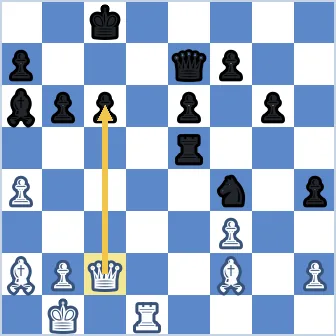
The whole assault lives or dies on whether a file opens, so that is the first thing to hunt for in each puzzle. Against a king tucked away after long castling, the targets are the pawns shielding it: a7, b7, and c7. A pawn lever like b4-b5 or a4-a5 trades off a defender and hands a rook a clear lane. Sometimes a piece does the prying instead, with Bxa6 (the bishop captures the pawn on a6) ripping the b7 pawn from its post or a knight crashing into b5 to hit c7 and force a weakening ...c6 or ...a6.
The solving habit to build: scan for the file the defender cannot keep shut. A half-open c-file aimed at c7 is often the first crack, and a doubled rook behind it turns a quiet edge into a threat. Once you spot the pawn cover splitting, the forcing moves usually line up in the order you need them.
Sort the puzzle first: race position or squeeze position
Opposite-side castling on the board means you sort it as a race. Both kings sit behind pawns that are now ammunition, so the puzzle reward is the move that rolls the a- or b-pawn (or a piece sacrifice) that opens a file a tempo faster than the defense can answer. When you see two exposed kings, stop counting material and count tempi to the first open file.
Same-side castling flips the test. There is no race, so the solving move targets a fixed weakness instead of speed. The tell is a backward black pawn on c6 with a half-open c-file in front of it: the answer piles a rook or knight onto that square. A queenside pawn majority is the other tell, where the move that makes a passer is the point.
Here is the one rule that sorts almost every position on the trainer: if both kings are exposed, calculate the race; if not, find the weak square first. The puzzles come from real computer-checked games, and the rating slider runs from about 400 up to 2400 so the race or the squeeze stays right at the edge of what you can solve.
Cashing in the weak square: c7, b7, and the back-rank finish
Opening a file is setup, not payoff, so on the trainer keep looking past it for the move that lands on one tender square. A rook or queen reaching c7 forks the back rank and a loose minor piece at the same time, and from c7 the seventh rank often sets up a mate on the back rank. The b7 pawn, once its bishop guard is gone, falls with check (for example Qxb7+, meaning the queen captures the b7 pawn and gives check) and drags the rook on a7 down with it.
The skill these puzzles drill is seeing the second move before you commit to the first. A check on a8 or c8 that the king cannot meet without dropping a piece is the kind of quiet finish these positions hide. When a defender's pieces are tied to the king on the queenside, a deflection on b7 or a knight check that wins the queen ends things fast. For the mirror image on the other wing, work the kingside attack puzzles next.