
Chess notation cheat-sheet (for new readers)
Pieces: K king · Q queen · R rook · B bishop · N knight · (a pawn move has no letter)
Actions: x takes · + check · # mate · O-O short castles · O-O-O long castles · e8=Q pawn promotes to queen
Annotations: ! good move · !! brilliant · ? mistake · ?? blunder
Reading the crisscross: where your eye lands first
The shape is two bishops aimed at one king from perpendicular, opposite-color diagonals, but at the board the scan does not start with the shape. It starts with the king. Find a king castled long on c8 or c1, then run two checks. First, name the long diagonal that already points at that king and confirm you own the bishop raking it. Second, find the second diagonal, on the opposite color, that could cross the first over the king's square, and see if your other bishop can land on a3 or a6 (the squares from which the second bishop delivers check) to fire down it.
Then count the jailers. The king is usually boxed in by his own crew, so list the flight squares and name who blocks each one. Picture a Black king on c8: a light-squared bishop on a6 checks down the a6-b7-c8 line, and a dark-squared bishop on f4 rakes f4-c7-b8 to seal b8, with c7 left empty so that bishop reaches through. His own pawns on d7 and d8 plug the rest. Drill that fixed order, king first, then the two diagonals, then the blockers, and the net shows up before you calculate a single line.
The c3 sacrifice that rips the diagonal open in Boden's mate chess puzzles
The diagonal is rarely open on its own. A pawn sits in the way, so the line needs ripping open, and that is where the sacrifice comes in. The classic is ...Qxc3+!! (Black's queen captures the pawn on c3 with check) against a White king. The point is not the check itself. It is that bxc3 (the b2 pawn recaptures the queen) drags the b2-pawn off its square, vacating b2 and clearing the bishop's path, after which Ba3# (the dark-squared bishop swings to a3 and delivers checkmate) or Ba6# from the other side finishes. The recapture has to be the b-pawn, and that recapture wrecks the king's own shelter.
The first time I worked through Schulder vs Boden, London 1853, the 14...Qxc3+!! 15.bxc3 Ba3# finish reframed the whole idea for me. Many of these positions are mate in 2 or mate in 3 that start by handing over the queen, so the solver has to see past the material before the bishops do the talking. At the board the tell is a defender pawn on b2 or b7 sitting between your bishop and the king: that pawn is the target, and any forcing move that makes it recapture toward the center is worth a hard look.
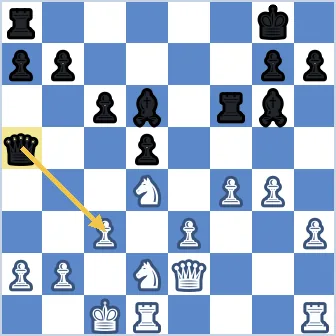
Boden's mate chess puzzles: the long-castled king that walks into the two-bishop net
Start your scan when the enemy king has castled long. A king on c8 or c1 with pawns and pieces clustered nearby is the standard target, because those friendly units block the flights that would otherwise save him. Confirm you hold both bishops, then check that one already rakes the long diagonal and the other can reach a3 or a6.
The pattern is not locked to the c-file. In Alekhine vs Vasic, 1931, the king sat on e8 and the bishops mated from g6 and a3, so the real signal is two crisscrossing diagonals converging, not one magic square. These puzzles pull computer-verified positions from real games, with a rating slider from 400 to 2400 tuned near a 75-80% solve rate. Stuck on one? Three free hints wait: the motif first, then the piece, then the move.