
Chess notation cheat-sheet (for new readers)
Pieces: K king · Q queen · R rook · B bishop · N knight · (a pawn move has no letter)
Actions: x takes · + check · # mate · O-O short castles · O-O-O long castles · e8=Q pawn promotes to queen
Annotations: ! good move · !! brilliant · ? mistake · ?? blunder
Reading the key move in mate in 2 chess puzzles
The first move is the whole problem. Solvers call it the key, and in a sound mate in 2 chess puzzles position it has to be unique: if two different first moves both force mate, the position is unsound. Your job is to find the one move that leaves Black with no escape on the next turn.
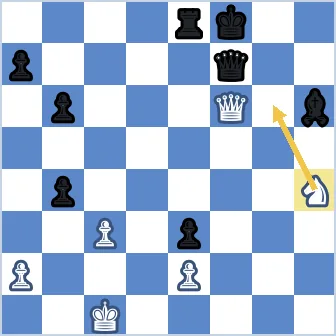
Scan in order of force. Checks first, then captures, then quiet threats. A check feels natural because it limits Black's replies, but plenty of mate in 2 positions refuse to start with one. Sometimes the key just sets up a threat so heavy that every legal answer walks into mate anyway. A short sample line shows the shape: Ng6+ (the knight jumps to g6 and gives check), the king has only Kg8 as a legal square, then Rxh8# (the rook captures on h8 for mate). If you want a softer warm-up before this, the one-move mates set trains the same king-cage instinct on a shorter clock.
Watch what the key gives up as much as what it takes. A move that opens a flight square for the king, or hands back a defender, can still be correct if each new Black reply has its own forced mate waiting. Read the move for what it allows, not only what it attacks.
Every defense, every reply: solving mate in 2 chess puzzles
The trap is settling for the line you saw first. The stipulation is mate against any defense, so a key that handles three of Black's four replies is simply wrong. One surviving move drops the position to mate in 3 or worse, and the puzzle counts it as failed.
So calculate every legal answer. After the key, Black may have several replies, each called a variation, and different defenses often need different mates. A pawn push that opens one square can unguard another, so the answer to 1...c3 (the c4 pawn steps one square forward to c3) is a queen mate that 1...a5 (the a7 pawn jumps two squares to a5 instead) would not allow. The same discipline carries straight into the three-move mate set, where one missed branch costs you the whole puzzle.
I keep a short mental list of Black's moves before committing, then I check that each one has exactly one mate. When the slider sits near my rating, the engine-verified positions push back hard enough to make that habit stick. I am Anton Shuravin, Lichess 1900+, and I built this trainer after years of losing won positions because I had stopped checking the quiet reply.
When a quiet move beats a check
The keys that fool strong solvers are the ones that look like they do nothing. A waiting move, a queen retreat to a far corner, sometimes a move that voluntarily frees the black king. These read as passive, so the eye skips past them while hunting for checks and captures.
Their logic is zugzwang. The threat is already in place, and any move Black makes worsens the position enough to permit mate. A king step into a freed flight square only meets a second mate; a blocking piece unguards the square it just left. Every reply has an answer prepared in advance. The same idea drives a lot of the zugzwang puzzles set, where the side to move has no good move at all.
Three free hints sit under each board for these moments: the first names the motif, the second points to the piece, the third gives the move. If a quiet key is hiding, the motif hint nudges you toward the threat without naming the move, so the find still belongs to you. From there, the natural step up is the full checkmate puzzles index, which mixes mate-in-N stipulations with named-pattern mates.