
Chess notation cheat-sheet (for new readers)
Pieces: K king · Q queen · R rook · B bishop · N knight · (a pawn move has no letter)
Actions: x takes · + check · # mate · O-O short castles · O-O-O long castles · e8=Q pawn promotes to queen
Annotations: ! good move · !! brilliant · ? mistake · ?? blunder
Mapping the king's escape squares in mate in 4 chess puzzles
The first thing to check in mate in 4 chess puzzles is which enemy king you are hunting and where it can run. Mark its escape squares, then count the attackers already aimed at that corner of the board. A forced mate exists because the defender, given best play, still cannot stop check number four. So you read the position backward as much as forward: picture the king walled in, then ask which of your pieces delivers the final blow and what has to clear out of the way first.
Note any defensive resources too. A spare flight square, a piece that can interpose, a saving capture. Each one is a branch you must answer. Scanning a four-mover, I list the candidate first moves that give check or make a concrete threat, then test only those. Pruning early keeps the calculation honest instead of hopeful.
Forcing-move chains that collapse the king's escape squares
Most solutions run on forcing moves: checks, captures, and threats that leave the defender one legal reply or none. Each forced answer narrows the tree, so a position that looked wide splits into two or three lines that all end in mate by move four. The pattern is steady. Drive the king, remove a guard, then close the net.
The finish is usually a known shape. A back-rank mate sends a rook or queen down the 1st or 8th rank while the king sits trapped behind its own pawns, often after a sliding check like Ra1+ (the rook drops to a1 giving check) that the defender can only block, not stop. A smothered mate ends with a knight, the classic Nf7# (the knight jumps to f7 delivering checkmate) against a king on h8 boxed by a rook on g8 and pawns on g7 and h7. Queen-and-bishop or queen-and-rook nets cover the rest. Deflection and decoy ideas pull a defender off its post so the mating square falls open.
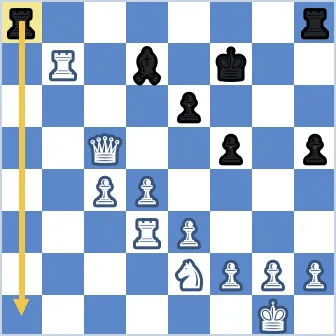
What separates mate in 4 chess puzzles from shorter combinations
A four-mover adds a full move pair of branching over a three-mover, which is where the difficulty really sits. More defensive tries means more lines to carry at once, so visualization, not just pattern spotting, decides whether you see it through. The key move is the opening move that holds against every defense; a line that lets the king survive past move four is not a solution, even if it wins material.
The hardest of these turn on a quiet move or quiet sacrifice, a move that gives no check yet builds the net so the threat next turn is unstoppable. Our positions are computer-verified and pulled from real games. Set the rating slider anywhere from 400 to 2400 for about a 75 to 80 percent solve rate, and lean on three free hints: first the motif, then the piece, then the move.