
Chess notation cheat-sheet (for new readers)
Pieces: K king · Q queen · R rook · B bishop · N knight · (a pawn move has no letter)
Actions: x takes · + check · # mate · O-O short castles · O-O-O long castles · e8=Q pawn promotes to queen
Annotations: ! good move · !! brilliant · ? mistake · ?? blunder
Reading the forcing line in mate in 5 chess puzzles
A forced mate in 5 ends on the fifth White move, the ninth ply: White plays, Black answers, and after five White moves the Black king sits in check with no legal reply. The trick at this depth is that almost every Black move is forced, so you are not branching into dozens of trees. You map one principal line, then check the handful of defensive tries that look annoying.
Work through replies in order. Checks first, since a check shrinks Black's choices to blocking, capturing, or stepping aside. Then captures and direct mate threats. Each Black answer should be near-forced; if Black has two reasonable moves, both need a mate, and both must land on move five. When one branch only reaches mate in 6, the move is wrong and you back up.
King hunts and quiet setup moves on the mate-in-5 board
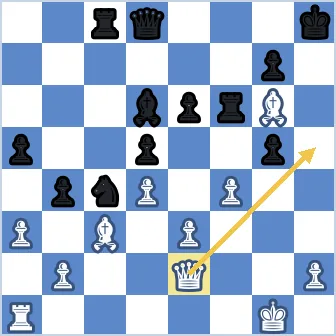
Two shapes show up repeatedly at this depth. The first is the king hunt: the enemy king gets dragged out by a string of checks, often after a queen sacrifice, and walked across the board to its grave. The Lasker versus Thomas game from London, 1912 shows the textbook geometry, with 1.Qxh7+ (the queen captures the h7 pawn with check) launching a chain of checks that herds the king from g8 down to g1, where it is mated. That particular hunt runs longer than five moves, but the driving pattern is identical.
The second shape is the quiet move. It gives no check and grabs nothing, yet it removes the last defender or seals an escape square, and after it the mate cannot be stopped. The quiet move tends to surface only after you exhaust every check, which is exactly the order you want: when the checks dry up but the king is boxed, look for the silent move that finishes the net.
What sharpens your calculation across these mate in 5 chess puzzles
Depth is what separates this from a mate in 3. Five moves means more candidate moves on each rank of the tree, so you train yourself to check every Black reply rather than the one you hope for. Miss a single legal escape and the whole line collapses. That habit of full candidate-move checking carries straight back into your games.
The positions here come from real games, every one computer-confirmed as mate in exactly five with best defense, not four and not six. A rating slider runs from about 400 to 2400 and is tuned so you solve roughly 75 to 80 percent of what it serves. Three free hints sit ready: the first names the motif, the second points to the piece that starts the sequence, the third gives the move. Use them when a line stalls, then try to spot the next one unaided.