
Chess notation cheat-sheet (for new readers)
Pieces: K king · Q queen · R rook · B bishop · N knight · (a pawn move has no letter)
Actions: x takes · + check · # mate · O-O short castles · O-O-O long castles · e8=Q pawn promotes to queen
Annotations: ! good move · !! brilliant · ? mistake · ?? blunder
Reading the Pillsbury's mate chess puzzles board: rook on the g-file, bishop on the long diagonal
Start by checking the g-file. If it is open and your rook can drop onto g1 or g8 with check, half the pattern is already on the board. The enemy king usually sits on g8 (or g1 in the mirror), boxed in by its own f- and h-pawns.
Now look at the long diagonal. A bishop on h6, g7, or somewhere along the a1-h8 line is what will seal the corner. The textbook line runs Rg1+ (the rook drops to g1 with check), the king is forced to h8, then the bishop swings to g7 with another check, the king steps back to g8, and Bxf6# (the bishop captures the knight on f6 with mate) finishes: the rook herds the king and pins it to the file, then the bishop arrives on g7 and captures on f6, taking the last defender and giving the mate. The rook never strikes the final blow. It cages, and the bishop kills.
So your read is two questions. Can the rook reach the g-file with check, and can a bishop reach the long diagonal to finish on the king's only escape? When both answers are yes, the mate is sitting right there.
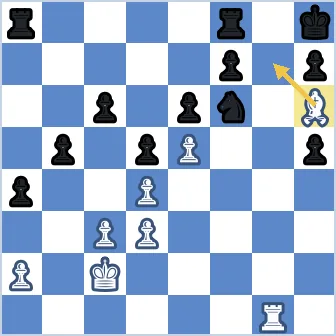
Setting up the trap before you solve Pillsbury's mate chess puzzles
The mate rarely appears fully formed. Two things have to happen first: the g-file must come open, and the king's pawn shield has to crack. A captured g-pawn, a luring sacrifice, or a trade that peels back the defense all do the job.
This is where a queen sacrifice often shows up. Give up the queen to rip open the g-file, or to drag a piece off the long diagonal. Then the rook check pins the king and the bishop arrives to finish. The first time I solved one of these from a real game, I sat on the queen offer for a while. It took me a moment to trust that a rook and a lone bishop would close the net. The trainer pulls computer-verified positions from real games, and you can slide the rating from roughly 400 to 2400 to keep your solve rate steady. Three hints wait if you stall: the first names the motif, the second points to the piece, the third gives the move.
Pillsbury versus Morphy: same bishop blow, different cage
These two mates are close cousins, and mixing them up costs solving time. In both, the bishop on the long diagonal lands the final move (Bxf6#, the bishop captures the f6 knight with mate). What differs is the cage around the king, not the piece that strikes it.
So before you commit, read the confinement. In Pillsbury's mate the rook sits on the open g-file, pinning the king to the corner while the bishop finishes. In Morphy's mate the king is hemmed in by the rook working with the king's own g-pawn, and only then does the same bishop swing in. Same killing diagonal, two different ways the king got trapped.
The family is wider than two members. The opera mate is a near relative, a rook mate supported by a bishop on the long diagonal, and Anderssen's mate sits nearby too. A bishop landing on h6 before the strike is a telltale Pillsbury detail. Sort the cage from the killing piece and these positions stop blurring together.