
Chess notation cheat-sheet (for new readers)
Pieces: K king · Q queen · R rook · B bishop · N knight · (a pawn move has no letter)
Actions: x takes · + check · # mate · O-O short castles · O-O-O long castles · e8=Q pawn promotes to queen
Annotations: ! good move · !! brilliant · ? mistake · ?? blunder
Reading a blind swine position before you move a rook
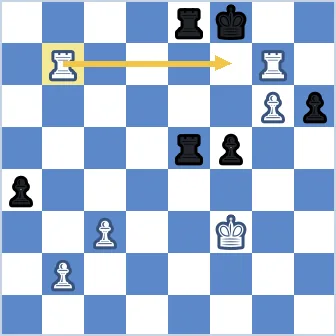
One rook already checks from the seventh; the other waits a square or two away, ready to swing in. Most solvers reach straight for the loud check and hope the king runs out of room. Resist that. Map where the king can legally go first. Picture a Black king on g8 with a White rook checking on g7 and the second rook poised to reach h7, and the king's candidate exits are f8 and h8.
Now test which of those two are dead. A Black piece still parked on f8, usually the king's own rook after castling, quietly removes the escape that would otherwise rescue the king. The corner square h8 dies the moment the second rook lands on h7 and covers the whole h-file. Seal both and the king is mated where it stands. Leave either one breathing and no rook swing will finish the job. Settle the exits first; the move follows from that count.
Blind swine mate chess puzzles: when the doubled rooks force mate, not perpetual
The finish rests on two rooks splitting the work. The front rook checks, landing on the king's file or the back rank. The rear rook earns its keep twice over: it defends the checking rook so the king cannot grab it, and it covers the single square the king would flee to. Close both doors and the king is mated where it stands.
Skip one door and you get a draw instead. Let the king reach h8 with f8 empty and unguarded: Rh7+ (rook to h7 with check) sends it to g8, Rag7+ (the a-file rook swings to g7 with check) pushes it to f8, Rf7+ (rook to f7 with check) drives it back to g8, and the loop repeats forever. That is perpetual check. At the board, run one test on every candidate before you commit: name the king's last flight square, then check whether one of its own pieces sits on it. If the square is occupied, hunt for the mate; if it is open, you are probably looking at a perpetual, the draw that earned these rooks the blind name.
Where these blind swine mate chess puzzles come from, and how the rating slider tunes them
Each blind swine you face here comes from a real game, computer-verified, not a tidy diagram someone drew to make a point. The rating slider stretches from roughly 400 to 2400 and tries to hold you near a three-in-four solve rate, so the shape repeats often enough to stick. When a position once stumped me, the three free hints told what I had missed: the first names the motif, the second points at the piece that does the work, the third gives the move.
Drill the recurring shapes until the read is automatic. Rooks on g7 and h7 finishing a king walled in on g8 by its own f8 piece. Doubled rooks climbing to the eighth rank to land the mate. The Black mirror, with rooks on the second rank hunting a White king. And the honest fake, the one that only draws by perpetual until an occupied escape square turns it into a back-rank kill. Tag each position before you move: real mate, or pigs that only draw.