
Chess notation cheat-sheet (for new readers)
Pieces: K king · Q queen · R rook · B bishop · N knight · (a pawn move has no letter)
Actions: x takes · + check · # mate · O-O short castles · O-O-O long castles · e8=Q pawn promotes to queen
Annotations: ! good move · !! brilliant · ? mistake · ?? blunder
Anastasia's mate chess puzzles: is the king sealed against the edge?
Every position in this set turns on one question: is the king sealed against the board edge? In the textbook shape the black king sits on h7 with its own pawn stuck on g7. A white knight on e7 quietly covers g6 and g8, the only two squares the king could slide to sideways. That leaves the h-file open, so a rook checking up the file lands the mate.
Train the scan in a fixed order so it fires in seconds. First, find the king on the rim. Second, check what blocks its sideways retreat, usually a friendly pawn or the knight itself. Third, locate the knight already doing escape-square duty. Once those three line up, the rook check is the mate or one move from it. Drill that order on every position here and the recognition starts to beat the calculation. Each position comes from real games and is computer-verified, so the win is always on the board to be found.
Building the net in Anastasia's mate chess puzzles starts with a sacrifice
Plenty of these positions don't hand you the net for free. You build it, and the trigger is almost always a sacrifice that opens the edge file or drags the king into the corner: Qxh7+ (the queen captures the h7 pawn with check) pulling the king out, or a black queen check on h5 that forces the g-pawn to capture and tears the kingside apart. The queen comes off, and the knight-and-rook coordination cashes in on the next move.
At the board, the tell to drill is the order. When a position stalls, resist firing the rook check first; ask whether the knight already covers both escape squares, and if it does not, the sacrifice or the knight move comes first. A common stall on this trainer is hunting for the check before the king is actually trapped, and a premature rook check just flashes "Not the move." and sends you to the next puzzle. Set the difficulty wherever you solve about three of four. If a position stops you, the first free hint names the motif and the second points at the piece, the third gives the move. Use them, then watch how often the sacrifice and the mate are two halves of one move order.
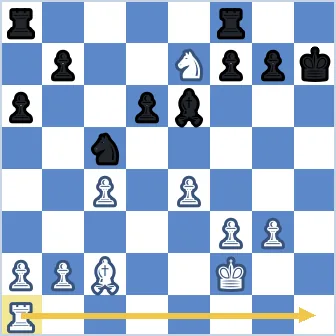
Spotting the right net before the file opens
Three nets look alike at speed because all of them pin a king to the edge, and the harder tiers mix them on purpose. The fast discriminator is which piece kills the escape squares: a knight means Anastasia's, a bishop on the diagonal pointing at the king means Greco's, and a rook-plus-knight backed by an extra pawn means the hook mate. Read that one feature first and you have named the pattern before you calculate a single line.
Two rotations show up often, so train for them. The same trap runs on the a-file as a mirror of the h-file shape, and a queen can stand in for the rook on the open file without changing the logic. Because the higher tiers move from mate-in-1 recognition into mate-in-2 and mate-in-3, the win often depends on parking the knight on its covering square before you open the file. Catch the family in the first glance and the move order writes itself.