
Chess notation cheat-sheet (for new readers)
Pieces: K king · Q queen · R rook · B bishop · N knight · (a pawn move has no letter)
Actions: x takes · + check · # mate · O-O short castles · O-O-O long castles · e8=Q pawn promotes to queen
Annotations: ! good move · !! brilliant · ? mistake · ?? blunder
Reading the board: how corner mate chess puzzles lock the king on h8
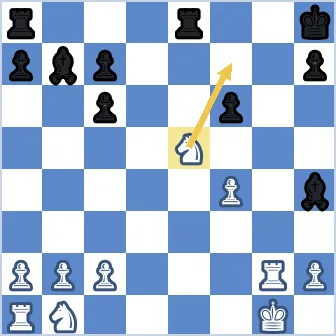
Start with the king. In the standard setup it sits on h8, which is the cramped square that makes these corner mate chess puzzles tick. A king on the edge already has few neighbors. In the corner it has only three to begin with, and the pattern strips every one of them.
Look at h7 first. After kingside castling (O-O, meaning the king and rook castle on the kingside) that square usually still holds the Black pawn, so the king cannot back away. Now scan the g-file. A rook parked on g1 sweeps the whole line, which covers both g8 and g7. With those two squares watched and h7 plugged by its own pawn, the king is fenced in before any check even lands.
So your reading order is simple. King in the corner, retreat square occupied, g-file owned. Once those three things line up on the board, you already know a mate is sitting there waiting for the knight.
What the knight-and-rook duo is actually doing in corner mate chess puzzles
The two pieces split the labor cleanly. In corner mate chess puzzles the knight is the one giving check, and a knight on f7 hits h8 along its L-shape. The other square that reaches a cornered h8 king is g6, so when the f7 jump is blocked, check the g6 route before giving up.
The rook does no checking at all. Its only job is to deny escape, and the g-file gives it both g7 and g8 in one stroke. A queen can stand in for the rook on the same file with the same effect, which is why some positions read as queen-and-knight instead.
That division is the whole trick. One piece attacks the king, one piece fences the exits, and the king's own pawn on h7 finishes the cage. Mate arrives the instant the knight checks a king that has no square to step to, for example Nf7# (the knight jumps to f7 delivering mate) or, from the other side, Ng6# (the knight lands on g6 with mate instead).
Where the corner trap shows up in your own games
This pattern lives near castled kings. Once your opponent castles short and leaves the h7 pawn home, the corner cage is half built already, and one open g-file plus a knight near f7 can finish it. The first time I drilled these, the trap turned up constantly in messy middlegames where a rook lift met a knight that had wandered to the kingside.
Watch for the forced versions too. Plenty of positions need a move or two of driving first, nudging the king from g8 into h8 before Nf7 (the knight hops to f7) lands. The puzzles here are pulled from real games and computer-checked, so the mates are genuine rather than invented. Set the slider to a level where the cage stays slightly tricky, and lean on the three hints, motif, piece, then the move, only when a position truly stalls.