
 By
By 
A blunder is a move so bad it can wreck your whole game in a single stroke: hanging a piece, walking into mate, or turning a clear win into a loss. In chess notation it earns the double question mark (??). Engines tend to flag it when your move sheds roughly two pawns of evaluation or flips a winning position into a drawn or lost one. Everyone blunders, from beginners to world champions. The goal is never a flawless game. It is just to make fewer serious errors than your opponent, and to spot the recurring slips that keep costing you points. This guide covers what actually counts as a blunder, the famous one-move disasters that show no rating is safe, the four (plus a couple of extra) ways players go wrong, and the practical habits that cut your error rate, including how to recover once the damage is done.
What is considered a blunder in chess? How bad a move has to be
A blunder in chess refers to a detrimental move that significantly impacts the evaluation of the position. These mistakes can be decisive and cost a game, and they include missed opportunities too. The distinction between an inaccuracy and a blunder lies in the extent of the mistake’s impact on the position’s evaluation. An inaccuracy represents a suboptimal move that doesn’t alter the evaluation significantly, while a blunder is a substantial error with potential decisive consequences. Losing material or failing to spot a checkmate threat would be an example of a blunder.
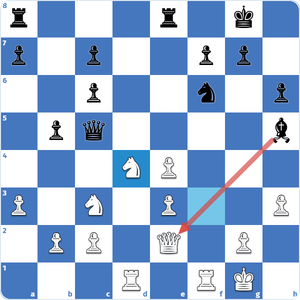
Example: White’s knight captures the pawn on d4, but this opens the d1–h5 diagonal, and Black’s light-squared bishop on h5 simply takes the white queen on e2.
Most games contain at least a few oversights, and no one is free from mistakes. Even the best chess players are bound to make mistakes sooner or later; the difference is that they make errors and inaccuracies far less often than weaker players. This means that one doesn’t have to play a perfect game but just needs to play better than their opponent as well as make fewer mistakes than the opponent.
How engines and annotation symbols classify a blunder (the ?!/?/?? scale)
In written analysis a blunder is marked with a double question mark (??) right after the move, for example 34…Qe3??. A single question mark (?) marks a mistake, and a question mark with an exclamation mark (?!) marks a dubious move or inaccuracy. These symbols come from standard chess annotation and tell you at a glance how serious an error was.
Engines put numbers behind those symbols. They compare the evaluation of the position before and after your move in centipawns, where 100 centipawns equal the value of one pawn, the bigger the drop, the worse the move. As a rough guide, the older Lichess thresholds treated a swing of about 50 to 100 centipawns as an inaccuracy, 100 to 200 as a mistake, and anything above 200, roughly two pawns or more, as a blunder. Modern tools such as Lichess and Chess.com have since moved to a win-probability model: they measure how far your real winning chances dropped rather than the raw centipawn number, which is why a slip in a dead-drawn position may be ignored while a smaller one in a sharp position is flagged.
The practical takeaway is simple: a move is a blunder when it hands your opponent a decisive swing, a free piece, a forced mate, or a winning-to-losing turnaround, whatever exact number the engine prints.
Inaccuracy vs mistake vs blunder: where the line falls
All three describe a move that is worse than the best one, but they differ in how much damage they do. The table below sums up the difference.
| Error type | Symbol | Approx. evaluation swing | What it usually means |
|---|---|---|---|
| Inaccuracy | ?! | about 0.5 to 1 pawn | A slightly imprecise move that lets some advantage slip but keeps the game on track. |
| Mistake | ? | about 1 to 2 pawns | A clearly wrong move that meaningfully worsens your position or wastes a winning chance. |
| Blunder | ?? | about 2 pawns or more | A serious error that often loses material or the game outright, such as hanging a piece or missing a mate. |
Famous blunders in chess history: one-move disasters that prove no rating is safe
Blunders are not only a beginner’s problem. Some of the most famous moments in chess history are decisive oversights by the very best players in the world. Two of them stand out.
Kramnik’s “blunder of the century” (Deep Fritz, 2006)
In game two of his 2006 match against the engine Deep Fritz in Bonn, world champion Vladimir Kramnik had a comfortable, roughly equal position with plenty of time on the clock. He played 34…Qe3?? and calmly stood up to leave the board, overlooking 35.Qh7#, a mate in one. It is the most famous case of a top player missing an immediate checkmate, and proof that no rating makes you blunder-proof. The safe move was 34…Kg8, when White has nothing better than a repetition with the knight.
Chigorin’s title-losing blunder (Steinitz, 1892)
The final game of the 1892 World Championship in Havana shows how much a single move can cost. Mikhail Chigorin was a piece up and one win away from levelling the match against Wilhelm Steinitz, with his bishop on d6 the only defender of the h2-square. He played 32.Bb4??, removing that defender, and after 32…Rxh2+ he resigned at once, since 33.Kg1 Rdg2# is a forced mate. A momentary lapse handed Steinitz the title.
Two more one-move disasters and the rule each one teaches
Kramnik and Chigorin are not alone. Two cleaner teaching examples come from modern practice. In Ganguly vs Madaminov, Black overlooked a forced mate on f2. A single careless move handed White a one-move finish that an engine flags instantly but a tired human waves through. The fix is the one that would have saved Kramnik too: when a position turns sharp, glance at the most forcing replies before you commit. The second example, Beliavsky vs Johannessen, is a king move that walked straight into mate on b8, a relative of the back-rank mate where the king had no escape square. The rule that follows echoes Chigorin: never play a move that strips your own king of its last shelter. Replaying disasters like these trains the pattern far better than memorising that blunders are bad.
Types of Blunders: Tactical, Strategic, Technical, and Psychological
To make fewer errors, it helps to know the different types of blunders. This becomes valuable when reviewing your games, aiding in identifying areas that require improvement.
Tactical Blunders
Tactical Blunders are the easiest to diagnose because they are very concrete in nature and less open to interpretation. Oftentimes, turning a chess engine on is enough, and it will easily pinpoint all the tactical mistakes that occur in a game. However, one needs to keep in mind that engines might sometimes exaggerate mistakes and suggest moves that are impractical from a human point of view. For example, it might suggest a long line leading to a clear win; however, all those moves might require surgical precision, and the path to victory feels like walking a tightrope. So the engine’s top move is not always the best practical move for you. Thus, considering the practicality of a suggested variation and how natural the follow-up moves feel is essential.
Tactical blunders, by definition, occur when you or your opponent overlook a specific tactical move with concrete implications, like capturing a free piece, checkmate threats, or various threats leading to material gain or loss through a particular tactical sequence. The primary causes of such oversights are often linked to two key concepts: board vision and tactical patterns.
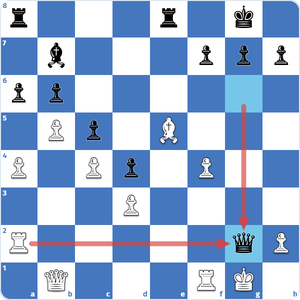
An example of a blunder that is related to the notion of a hanging piece, is seen above in the diagram. Black has just captured the pawn on g2 with the queen, thinking that it would be a checkmate as the bishop on b7 supports the queen as well. However, black has failed to notice white’s rook on a2, which can actually now capture black’s queen, resulting in a decisive material advantage for white. Hanging pieces are the most basic form of tactical oversight. They are related to paying attention to the range of capture of each piece on the board as well as board vision.
A quick cure for these types of mistakes is to double-check which squares each piece controls and the potential threats they pose. With dedicated practice, understanding the range of movement for each piece becomes second nature, helping you stay vigilant for any hanging pieces.
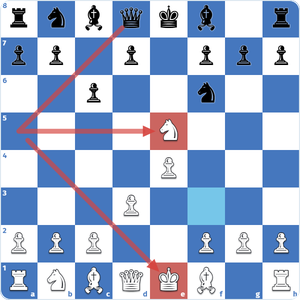
Falling into tactical traps, neglecting opponent threats, and failing to read the intentions of opponents are often the common causes of tactical blunders. This goes beyond the simple mistake of ‘hanging pieces,’ where immediate captures are possible. Instead, this type of failure involves overlooking specific tactical motifs, such as pins, skewers, discovered attacks, double attacks, and so on. In the diagram above, white has just captured the pawn on e5 with the knight, overlooking black’s tactical trap, …Qa5+, forking the knight on e5 with check and winning material.
The main remedy for these types of tactical blunders is to improve your pattern recognition skills through practice. This can be achieved, for example, by solving a lot of chess puzzles in order to familiarize yourself with the motifs. Also during the game, after each move of your opponent, ask yourself: “What is the purpose of my opponent’s move? Does it threaten anything?”. Making this a habit will increase your tactical awareness immensely.
Strategic Blunders
Strategic Blunders are much sneakier than tactical ones and, therefore, harder to detect. These are usually related to knowledge, and you don’t know what you don’t know, which makes it hard to see where you are going wrong and fix it. When we speak about strategic blunders, we refer to things like choosing the wrong plan, inability to assess the position correctly or to understand the priorities in a given position, or simply losing the thread.
The cure for these types of errors is relatively complex compared to the tactical ones Having a coach highlight the themes that one struggles with most would be ideal; however, there are high quality books to improve your positional understanding, such as The Wisest Things Ever Said About Chess by Andrew Soltis or Positional Chess Handbook: 495 Instructive Positions from Grandmaster Games by Israel Gelfer. Strategic Blunders are minimized when one develops strong intuition and a feel for the ‘spirit of the position’.
Technical Blunders
The hardest thing in chess is said to be ‘to win the won positions’. In other words, converting an advantage into victory is oftentimes not a trivial task. Failing to convert an advantage is what we call a technical blunder. A typical scenario in the case of a technical failure involves gaining an advantage in the middlegame but failing to capitalize on it during the endgame, resulting in a drawn game. To address this issue, one should prioritize studying essential endgames. Additionally, gaining experience through numerous practice games can enhance one’s technique.
Psychological Blunders
Psychological blunders are errors not directly tied to chess skill; rather, psychological factors contribute to such mistakes. These factors, connected to one’s mental state, may include stress, mood, overconfidence, underestimation of the opponent, or excessive respect for the opponent. Physical fitness can also be a factor, with tiredness, brain fog, and changes in blood sugar levels known to impact performance. Together these factors cause tunnel vision and lost focus, and you end up playing below your level.
Time pressure is one of the most common causes of an increase in stress levels, leading to bad moves. If a player repeatedly gets into Zeitnot (a chess term describing being low on time), the cure is to work on better time management. Here are examples of methods that you can apply for that purpose:
– Allocate Time Wisely: Divide your time for each phase of the game: opening, middlegame, and endgame, and before the game, make a plan about how much time you approximately want to spend on each phase.
– Review Time Management: After each game, analyze how you utilized your time. Identify moments where you spent too much or too little time
– Avoid Perfectionism: ‘If you see a good move, look for a better one’ sounds like good advice; however, seeking out perfect moves consumes too much time. It is usually more practical to aim for good-enough moves within a reasonable timeframe and save time for the critical moments in the game.
Two extra blunder types: opening and compound mistakes
The four-bucket model is tidy, but two more categories deserve their own label. An opening blunder happens before the middlegame even begins: you walk into a known opening trap, lose a tempo chain, or hang material to a standard idea you never studied. These are among the most avoidable errors, because the cure is just learning your lines a few moves deeper. A compound mistake is subtler. One inaccuracy is not fatal, but a second careless move on top of it turns a small slip into a lost game. Many decisive errors are really compound mistakes, where panic or stubbornness after the first error produces a worse second one. Realizing that a single inaccuracy (?!) need not snowball into a blunder (??) gets you most of the way. The rest is staying calm enough to play the best available move once the position has soured.
How do I avoid or reduce blunders in chess? A methodical approach
Reducing or avoiding decisive errors in chess involves a methodical approach, starting with a thorough review of your games. I recommend creating a spreadsheet with the categories of blunders listed in this article as titles. Go through each game, marking the corresponding type of mistake. Over time, a pattern will emerge. Identify the types of mistakes that occur most frequently and address them. If you frequently miss tactical opportunities, focus on puzzles and calculation exercises. If you struggle strategically, delve into relevant books for deeper insights. If your mistakes are linked to a lack of focus or a cloudy head, work on improving your mental clarity and psychological aspects of the game.
How to find your own blunders: a game-review workflow
Spotting blunders in your own games is a skill you can systematise. Start by running every serious game through an engine on Lichess or Chess.com and reading the move list for the biggest evaluation drops, the centipawn swings the engine marks with ?, ?? and ?! symbols. Do not stop at the engine’s verdict, though. At each flagged move, pause the engine and replay the position yourself, working through the forcing moves, the checks, captures and threats, until you understand why the move failed and what you should have seen. Note the type of error, whether it was tactical, strategic, technical or psychological, in a running log or spreadsheet. After a dozen games a clear pattern emerges, and that pattern tells you exactly what to train next. Reviewing this way turns a pile of losses into a targeted study plan instead of a source of frustration.
A simple blunder-check before every move: the CCT scan
Reviewing finished games shows you where you go wrong; a fixed routine stops the error before you make it. Before you let go of a piece, run through a short mental checklist:
- Is the move I want to play safe? Check whether the piece you are moving, and the square it lands on, can be captured for free.
- What did my opponent’s last move threaten? Every move has a purpose, find it before you reply.
- Are there checks, captures or threats for either side? Look at the forcing moves first, both yours and your opponent’s.
- Did my move leave anything undefended? Moving one piece often abandons another, exactly the slip that cost Chigorin the world title.
This takes only a few seconds once it becomes a habit, and it catches the great majority of one-move blunders.
How to recover after you blunder
A blunder feels like the end of the game, but it rarely is. The first job is emotional: resist tilt. Letting one error spiral into anger or despair is how a single slip becomes a string of compound mistakes, so take a breath, accept that the position has changed, and assess it from scratch as if you had just sat down. Look for practical chances rather than the perfect refutation. Set your opponent problems, keep pieces on if you need complications, and make the conversion as awkward as possible, because even strong players misplay winning positions under pressure. If you have given up material, look for activity, a fortress, or perpetual check before you resign. Staying positive is not just sportsmanship. It directly wins half-points, since an opponent who relaxes after winning material is one careless move from handing it straight back.
If you blunder again and again, the cause is usually one of a few things: playing too fast and skipping the check above, fatigue or time trouble that narrows your vision, or weak pattern recognition that hides tactics you have never studied. The cure matches the cause: slow down on critical moves, keep your clock under control, and solve tactical puzzles regularly so the common motifs become automatic. Blundering less is a skill you train, not a talent you are born with.
When blunders actually happen
Blunders cluster around predictable triggers rather than striking at random. Time trouble, or zeitnot, is the biggest. Once the clock bites, your blunder check collapses and chess blindness sets in, and you stare straight past a hanging piece. Sharp, complicated positions are the next danger zone, because the sheer number of forcing moves overloads your calculation. Fatigue late in a long game, or a sudden drop in concentration once you reach a comfortable position, produces the classic relaxed blunder, exactly the trap Kramnik fell into. Position-defining moments are riskier than quiet ones, so that is where your time and attention should go. In my own blitz games the relaxed blunder is the one that stings most: I win the exchange, exhale, and hang a rook three moves later. Knowing your personal trigger conditions lets you raise your guard right when a slip is most likely, instead of spreading equal vigilance across every move.
How blunders change from 800 to 2000 Elo
What counts as a typical blunder shifts dramatically with rating. Around 800 Elo, games are decided by raw hanging pieces and missed one-move captures. Both players leave material en prise repeatedly, and simply running a basic blunder check would lift the result overnight. By roughly 1200 to 1500, outright hanging pieces grow rarer and the damage moves to two- and three-move tactics: missed forks, pins and back-rank mates that demand a little calculation. Approaching 2000, clean material blunders become uncommon, and most decisive errors are strategic or technical, such as the wrong plan, a mishandled endgame, or a single inaccuracy that snowballs under time pressure into a compound mistake. So your training should track your rating band. Beginners get the fastest gains from a disciplined pre-move check. Stronger players win more by sharpening positional judgment and endgame technique.
FAQ's
What is the biggest blunder in chess history?
Mikhail Chigorin’s move in the final game of the 1892 World Championship match against Steinitz is widely regarded as one of the most damaging blunders ever played. He removed the only defender of a key square and let Steinitz force mate, and that single momentary oversight cost him the world title.
How many blunders are too many in chess?
It depends on the level. In a game between masters, even a slight inaccuracy can be decisive, so a single blunder may settle the result. Games between less experienced players usually contain several mutual blunders spread across the game, and the player who blunders less often tends to win.
How do I stop hanging pieces?
Before every move, check which of your own pieces are undefended and what your opponent can capture for free. Make that quick scan a fixed habit, and you remove the most common type of blunder almost entirely.